Managed IT Support & Outsourced Technical Operations

PulseTechnologies helps businesses run managed IT support, outsourced technical operations, and practical infrastructure coordination—with service continuity, monitoring readiness, and scoped remote, on-site, project-based, or recurring engagements.
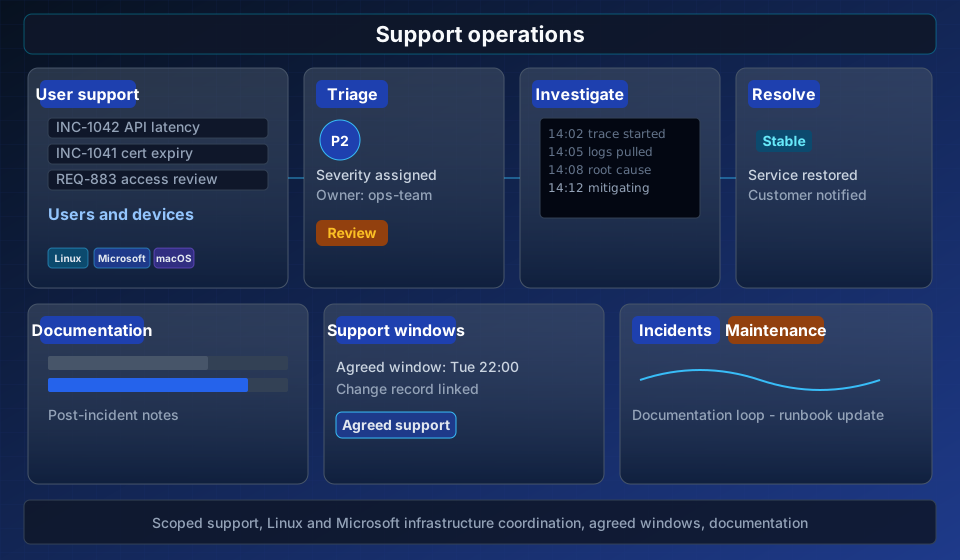
Support that is scoped and practical

Support works best when ownership, channels, expectations, escalation paths, and recurring review points are clearly defined. We help shape support around how your team actually operates—whether that means user support, infrastructure coordination, operational reviews, or additional technical capacity.

  • Recurring managed support
  • Project-based support
  • Remote support
  • On-site support depending on location and requirements
  • Operational reviews
  • Technical resourcing where relevant

The aim is to create a support model designed to support continuity beyond a single issue or request.

What we support

Managed IT and operational support from user environments through to infrastructure coordination—with support scope and expectations agreed during engagement planning.

Managed IT and end-user support

  • User support during agreed engagement windows
  • Endpoint assistance and device coordination
  • Helpdesk coordination and issue routing
  • Day-to-day support ownership alignment

Microsoft, Windows, and macOS environments

  • Microsoft environments where applicable
  • Windows workstation support
  • macOS support
  • User environment coordination

Access, accounts, onboarding, and offboarding

  • Account administration
  • Onboarding coordination
  • Offboarding coordination
  • Access and permission support

Linux and Microsoft infrastructure support coordination

  • Linux infrastructure support coordination
  • Microsoft infrastructure support coordination
  • Windows Server support where appropriate
  • Escalation and operational ownership alignment

Monitoring readiness and operational troubleshooting

  • Monitoring readiness and alert review
  • Incident support during agreed engagement windows
  • Operational troubleshooting
  • Maintenance planning

Documentation, continuity, and support improvement

  • Technical documentation and support notes
  • Support process improvement
  • Escalation context and operating notes
  • Recurring review support

How support can be structured

Support can be delivered in different ways depending on engagement, location, service requirements, and internal team capacity. We help define how requests are raised, how work is prioritised, which issues need escalation, and when additional technical resources are needed.

  • Remote support
  • On-site support depending on engagement and location
  • Hybrid remote/on-site engagement
  • Recurring managed support
  • Project-based support
  • Technical resourcing / staff augmentation

Support windows and response expectations are agreed during engagement planning. We scope this honestly around your environment, service model, location, and operational needs.

Support model examples

Recurring support

Scheduled reviews, user support coordination, operational checks, and ongoing improvement work.

Project-backed support

Focused support around migrations, infrastructure changes, onboarding/offboarding, or monitoring improvements.

Resourcing support

Short-term or longer-term technical capacity to support internal IT teams, Linux/Microsoft infrastructure work, or operational projects.

Support outcomes

The goal is to make support easier to operate over time, with clearer ownership, better routing, and stronger continuity between users, infrastructure, and operations.

Clearer support ownership Users, endpoints, and infrastructure issues route to accountable handling paths.
Better user and endpoint support rhythm Day-to-day support aligned to agreed engagement windows and expectations.
Improved infrastructure support coordination Linux and Microsoft layers connected to user and operational support.
Stronger documentation and support continuity Notes, process context, and recurring review support that help teams operate confidently after incidents and changes.

When to engage us

  • Users need reliable day-to-day IT support
  • Onboarding or offboarding needs better coordination
  • Internal IT needs extra technical capacity or outsourced support resources
  • Linux or Microsoft infrastructure support needs coordination
  • Monitoring, documentation, or support continuity is incomplete
  • Support requests are being handled inconsistently across users, systems, or locations
  • Recurring operational reviews would help reduce noise
  • You need a practical retained support model without building a full internal team

Related services

Need a more structured support model?

We can help review how support is handled today, identify gaps, and build a practical support model around users, devices, systems, and operations.